
Blogs
Young Adult vs Adult Fantasy Explained

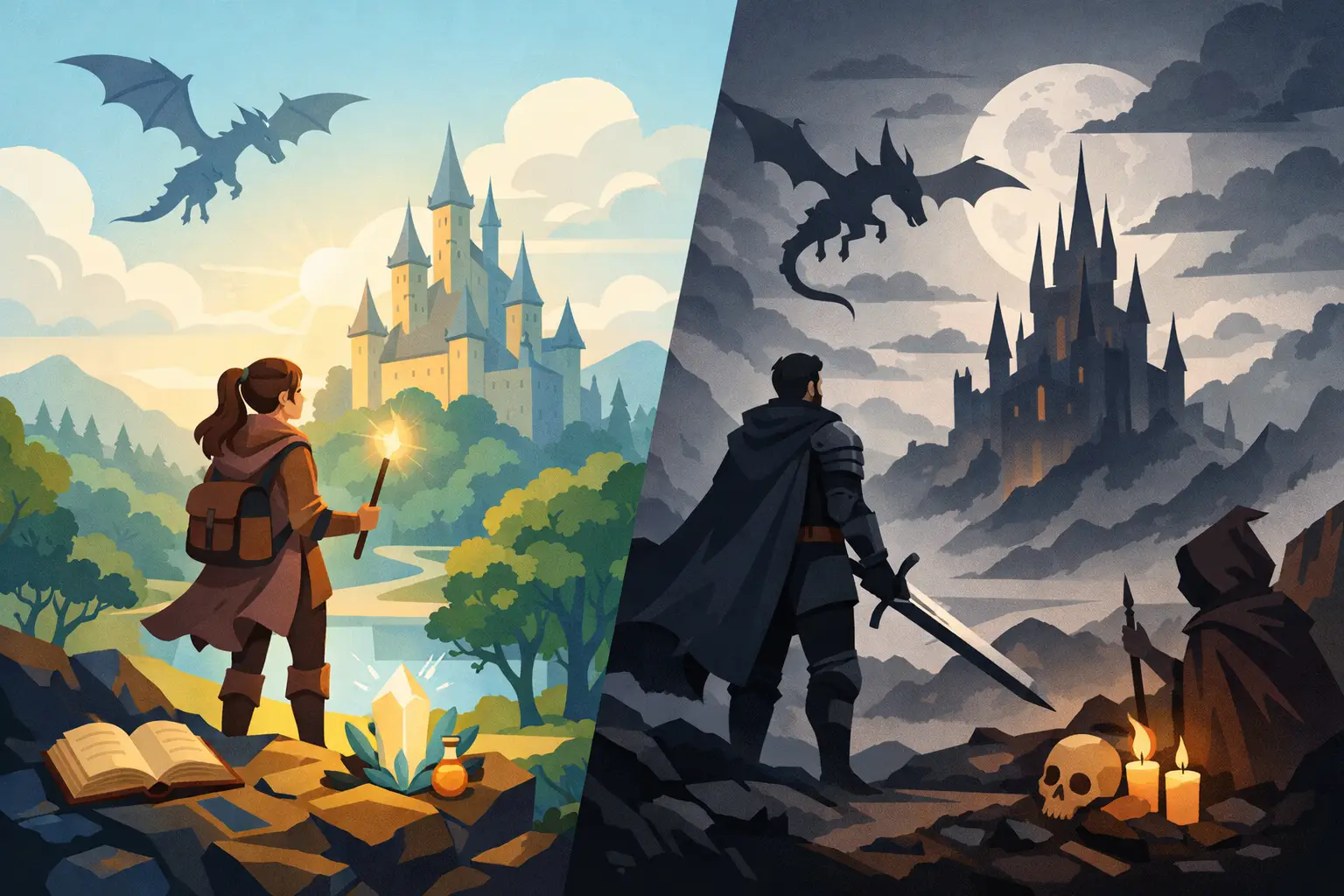
One reader picks up a fantasy novel for the thrill of a first brave choice. Another wants kingdoms on the brink, morally tangled alliances, and the weight of every sacrifice. That tension sits at the heart of young adult vs adult fantasy, and it matters more than a character’s age on the cover copy.
Fantasy readers often hear these categories treated like a hard border. They are not. They are more like neighboring realms with shared creatures, shared magic, and very different ways of telling a story. If you love epic adventures, dangerous quests, and characters who fight for something larger than themselves, knowing the difference helps you find the stories that truly fit your mood.
Young adult vs adult fantasy: what really changes?
The clearest difference is not complexity, and it is definitely not quality. Young adult fantasy is usually written with a teen audience in mind, while adult fantasy is written for adult readers. That sounds obvious, but the real shift happens in perspective.
Young adult fantasy tends to stay close to the emotional immediacy of the protagonist. Everything feels urgent because it is urgent to that character. Identity, belonging, loyalty, betrayal, courage, first love, and the shock of discovering what kind of person you will become often drive the story as much as the external plot. The world may be enormous, but the lens is intimate.
Adult fantasy can still be intimate, but it often widens the frame. It may spend more time on institutions, political systems, history, war, social structure, faith, class, or the slow consequences of power. The emotional stakes are still there, but they are often tied to harder compromises. A hero may not simply ask, Who am I becoming? They may also ask, What am I willing to destroy to protect what matters?
That difference in emotional framing changes everything from pacing to prose style.
It is not just about the protagonist’s age
This is where many readers get tripped up. A teenage protagonist does not automatically make a book YA, and an adult cast does not automatically make it adult fantasy.
A YA fantasy novel is usually shaped around a teen reading experience. That often means the main character is a teenager, the themes reflect formative life moments, and the narration carries immediacy and momentum. The story may move with a sense of discovery, rebellion, and transformation. Even when the fate of a kingdom hangs in the balance, the beating heart of the book is usually personal.
Adult fantasy has more freedom to center older characters, layered timelines, slower burns, and conflicts that do not resolve cleanly. It can ask the reader to sit longer with ambiguity. It can also be more patient with setup, denser in worldbuilding, and more willing to let trauma, grief, duty, or corruption shape the plot without softening the edges.
Still, there is overlap. Some YA fantasy is dark, sophisticated, and politically sharp. Some adult fantasy is swift, accessible, and full of wonder. The label tells you the intended audience, not the ceiling of the story.
Voice, pacing, and emotional intensity
If you want the fastest way to feel the difference between young adult vs adult fantasy, pay attention to voice.
YA fantasy often has a stronger sense of forward motion. The prose may be vivid and emotionally direct. Chapters frequently end on turns that pull you onward. There is less distance between the character’s fear, hope, anger, or longing and your experience of the page. That immediacy is part of the genre’s power. When a young hero chooses courage over safety, it can feel electric.
Adult fantasy may use a broader range of narrative distance. Some books are lush and lyrical. Others are sharp, grim, or spare. Many adult fantasies take more time to build atmosphere, deepen political tensions, or show multiple sides of a conflict before unleashing the full storm. The reward is often a greater sense of scale and consequence.
Neither approach is better. It depends on the kind of reading experience you want. If you want a story that grabs your heart and sprints, YA may be the right door. If you want a story that lets the world gather weight around every choice, adult fantasy may be the stronger fit.
Themes and darkness in YA and adult fantasy
A common myth is that YA fantasy is lighter and adult fantasy is darker. Sometimes that is true. Often it is not.
YA fantasy can deal with war, oppression, death, cruelty, and grief. It can be brutal. The difference is usually in how those elements are framed. Even in dark YA, there is often a current of becoming. The pain means something in relation to growth, agency, and the forging of identity. The story may leave scars, but it often keeps one eye on possibility.
Adult fantasy may be more willing to stay in moral gray areas without offering clean reassurance. It may show systems that cannot be fixed by one heroic act. It may let victory come at a devastating cost. It may also include more explicit content, whether that means violence, sexuality, or psychological damage, though that is not a rule.
This is where reader expectation matters. If you want emotional uplift alongside danger, both categories can deliver it, but they do so differently. YA often burns with hope in the middle of chaos. Adult fantasy may ask hope to survive after chaos has already changed everything.
Worldbuilding: intimate lens or wider map
Fantasy readers care deeply about worldbuilding, and this is another place where the distinction shows up.
YA fantasy usually reveals the world through what the protagonist urgently needs to survive, understand, or overcome. You learn the rules of magic, the shape of power, and the danger in the shadows as the hero collides with them. This keeps the story moving and makes the world feel immediate.
Adult fantasy is often more willing to explore the machinery behind the curtain. You may get fuller histories, competing political interests, religious tensions, military structures, and economic realities. That can create a richer sense of immersion, but it can also demand more patience from the reader.
For readers who love endless worlds and one legendary journey, both paths have real appeal. One gives you the rush of discovery. The other gives you the grandeur of a living realm with deep roots and far-reaching consequences.
Which one should you read?
The better question might be, what do you want right now?
If you want a fantasy that feels propulsive, emotionally immediate, and centered on identity, loyalty, and transformation, YA fantasy may be exactly what you need. It is especially powerful when you want that feeling of standing beside a hero at the edge of the unknown, where every choice feels like the first step into destiny.
If you want layered politics, heavier trade-offs, older characters, or a story that wrestles more openly with power and compromise, adult fantasy may be the stronger match. It often suits readers who want to linger in the world, measure the cost of survival, and see how courage changes when innocence is long gone.
Of course, many readers love both. Plenty of fantasy fans move between categories depending on mood. One week you may crave a fierce coming-of-age adventure. The next, you may want a sprawling conflict where every alliance comes with a price.
That flexibility is not confusion. It is part of the joy of the genre.
Why the label matters less than the promise
The best fantasy, whether YA or adult, makes a promise and keeps it. It promises wonder. It promises danger. It promises that choices matter and that the characters will be tested by more than monsters alone.
A great YA fantasy can feel as epic and emotionally lasting as any adult saga. A great adult fantasy can carry as much heart and momentum as the most gripping teen adventure. What matters is the shape of the journey, the clarity of the stakes, and whether the story gives you someone worth following through fire.
That is why readers who love heroic through-lines, magical worlds, and courage under pressure often cross the aisle without hesitation. If a fantasy novel offers high stakes, emotional truth, and the kind of quest that keeps you turning pages late into the night, the category is only the beginning.
For readers who want stories filled with loyalty, peril, wonder, and the fight to protect the innocent, the real victory is not choosing sides in young adult vs adult fantasy. It is finding the kind of adventure that meets you where you are and still carries you somewhere unforgettable.
The next time a fantasy book catches your eye, do not ask whether the label makes it worthy. Ask what kind of journey it promises, and whether you are ready to answer the call.